Sunday, January 13, 2013

Creating summer mood

Maria 3.5 y.

There is a snowstorm, dark and cold outside and, therefore, we decided to organize a piece of summer in our flat by drawing, gluing and making some attributes of this warm and green time.
1.       Summer field with flowers and insects
Painted with watercolours, made flower stamps out of the toilet paper reel, modeled insects out of clay. We prepared the ladybirds according to the guidelines and then sticked them to the summer field. The whole work was purely done by Maria – I just helped to cut out the ladybirds.
2.       Fun and easy summer scenery we made pretty fast thanks to these videos: 1, 2, 3, 4, 5. The exciting part of this work is that it grabs the attention of the very active children: you don’t have to care about your accuracy, you don’t have to care too much about the colours you use and it is very interesting to figure out what kind of animal you’ve painted.


3.       Salt Dough Cornflowers
Salt dough (2 glasses of flour, a glass of salt, a glass of water) is really good one for the finger work out. Besides, one can realize his talent when modeling some figures. Another benefit is its cost compared to  the pricey colourful dough found in the craft sets.
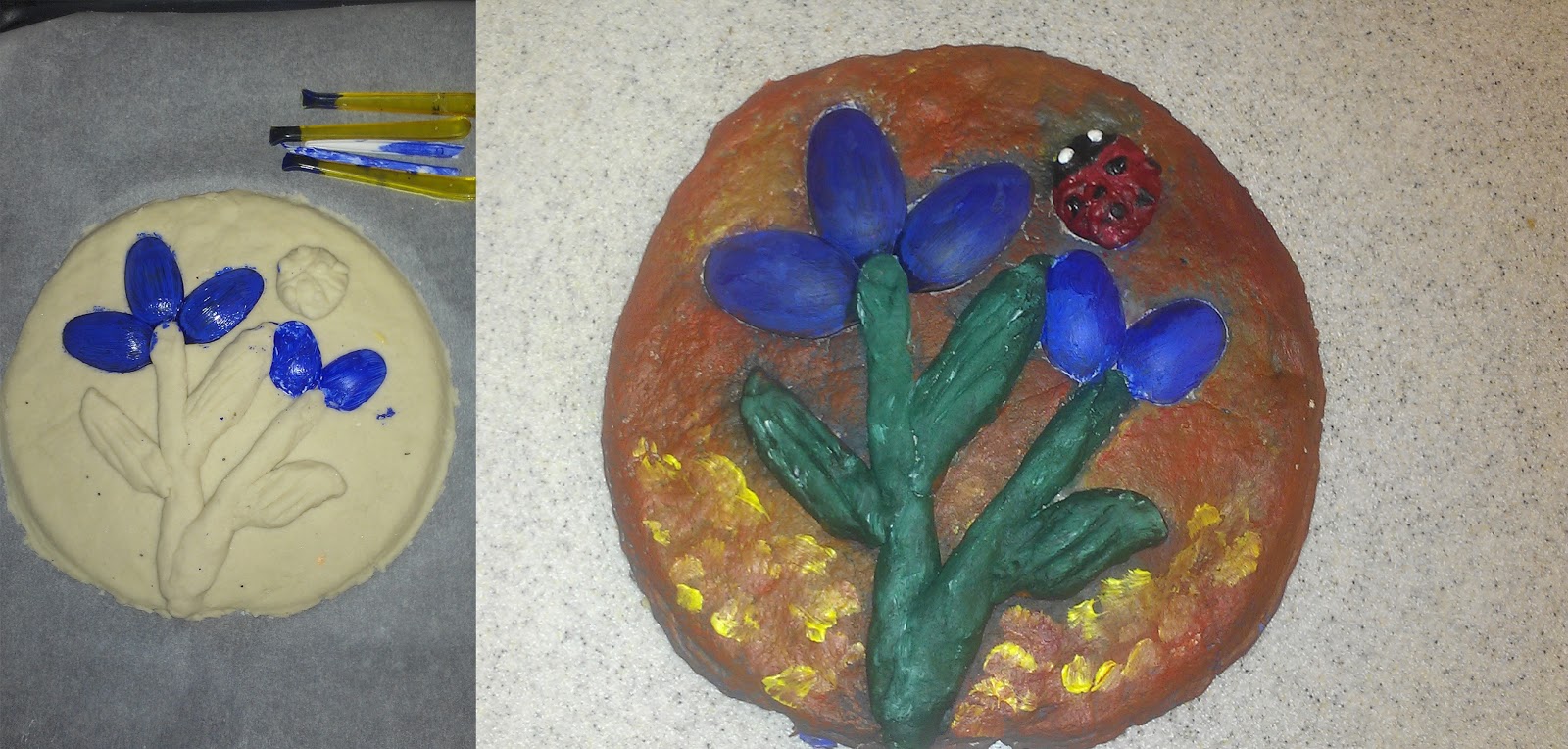
 We used the dough to make a panel with cornflowers and a ladybird. We made the buds of cornflowers out of plastic teaspoons, coloured them in blue with acrylic paints, snapped the edges and fixed them in the dough. Then, dried the panel in the oven and finished the panel with the acrylic painting.

Friday, December 28, 2012

10 Favourite Nursery Rhymes to Study English

Maria 3y. 7m.
 
For our English “lessons” we organized a special so called “English Zone”, where we have UK’s map, English books, an envelope with cards for articulatory gymnastics, different animals’ masks and other requisite.  This all is needed for our fun lessons, where the majority of exercises are done by performing some actions like running, jumping, drawing, modeling etc. But the most adorable part of the English studies (except for catch-up game, of course) is singing and finger-playing. Maria learns the nursery rhymes one by one and does it with pleasure remembering the words and repeating them all through the day. here is the list of her most favourite songs:
 
These two songs we sing and move the respective transport mean on our UK map and then make particular exercise such as drawing or gluing or making articulatory gymnastics.
 
Excellent finger/body play!
 
6. Head, Shoulders, Knees and Toes
Very good when one needs to study parts of the body


Absolutely top hit when studying colours

 
And of course the lovely classics such as:
8. Old Macdonald Had a Farm

10. London Bridge is Falling Down

The most favourite songs are definitely those, which are sung by the children.

Tuesday, December 18, 2012

Get Active with Little Ones


Andrew 4 m.
 
At his age of 4 months Andrew is rather well-developed: swims and dives with pleasure, rolls around, stands on his fours (to prepare himself for creeping), sings and speaks with his toys and his family members, is able to play independently for some 15 to 30 min. So, what are our time and effort investments for Andrew to develop physically and mentally? Here is the list of things we do (almost) every day:
1.    5 min fit ball exercises;
2.    10-15 min massage;
3.    5 min exercise on inflatable ball;
4.    Listening to various types of music, but primarily classics;
5.    30-40min swimming;
6.    Reading and singing nursery rhymes. Also Andrew becomes active listener when we read to Maria short stories.
Gymnastics with mum is another option to be added to the list for the mum and baby to be fit.
 
Besides, Andrew and Maria enjoy speaking and playing together, which undoubtedly stimulates mutual development and learning. It is said, that second, third, fourth children develop faster than their older siblings.


Tuesday, December 11, 2012

Playreport: Kids want to Play with Parents!

What is a Play according to children: Building, Reading, Role play, Exercising, Creating, Thinking, Dressing Up, Cooking

 
 IKEA has undertaken a major research-driven project to investigate the subjects of children's development and play called the Playreport. 7,933 Internet-based interviews were conducted with parents and 3,116 interviews with children aged 0-12 years during October and November 2009.
The good thing discovered during the study is that the kids preferring 9 to 1 to play with friends and their parents over watching TV. However, there were also some worrisome findings:  
·         45% of parents feel they don't have enough time to play with their children
·         26% agree that they're too stressed to play with their kids
·         46% of parents admit to feeling guilty about not spending enough time with their kids
Very interesting results were obtained when asking single, wide-ranging question that invited them to tell us in their own words, ‘If you could wish for anything, what would that be?’ It's needs to be noted that a significant of children wishes are not to difficult to fulfill.
“To be an Olympic swimmer”
 “A time machine. A library”
“A TV in my room”

 “(I wish that) we lived in New Zealand - it looks wonderful, beaches are great”

“To grow up to 16”

“My own laptop”

“Liverpool to win the league”

 “A pony”

“To live in the country and have lots of animals”

“To get a good job and be happy and have lots of holidays”

“That my school friends lived closer so that we could meet up and play more, especially at the park”

“I would wish that me and my mum could spend more time with each other and go to the park and bake things. I would also like my mum to take me to places like swimming pools and the zoo and farm. I would wish that we could all eat together like a proper family (with no TV.) I would like to do art with my mum and Christmas cards and decorations. (I would like to have some more takeaways as well.)

“To go to a dance school and to be famous and rich”

 “I’m happy as I am”

“To be a professional footballer with lots of money”

“To have my nanny back from heaven as she used to play with me a lot and let me do fun things! That's it”

“A brilliant life and loadsa friends!!!!!!!!!!!!!!!!!!!!!!”

“I wish I could go a visit my big sister in America for a long holiday”

Wednesday, November 28, 2012

November Table Games

Maria 3,5 y.

We’re trying to establish family tradition – playing table games Friday evenings. It’s the moment of family unity and overall comfort as well as fun and excitement.
The ideas of the following handmade games were seen in the Internet, but they were slightly adapted to our preferences. The games we prepared ourselves and the work was mainly done by Maria (of course, the squirrel was drawn by me :)), who was really eager to start playing.

1.       Colours Memory Game
   2.      Nuts eating - a very good one for those, who wants to learn the basic colours (when playing with Maria we speak foreign language for her to expand her vocabulary in other than native language) and also for those, who loves nuts. Every player starts on the square of the same colour as his cup. Then, the player throws a dice and moves his cup. If the colour of the cup coincides with the colour of the square, then the player takes a nut, cracks it and puts it into his cup. The game stops until there are no nuts left. The winner is the one who has more nuts than the others.
 

Friday, November 16, 2012

Independent second-born children

Andrew 2 m.

Research results demonstrate that the first-born children are more likely to conform, while the second-borns appear to be more independent, rebellious and adventurous. Second born children are competitors. Though these traits of character vividly appear in the adolescent phase, Andrew being only 2 month old appears to be very independent. He can easily play on his own for some 20 min. If someone is nearby and he hears or sees smb, he can extend his independent playing time even for an hour unless he feels uncomfortable (e.g. wants to eat, to sleep).
With Maria we made a toy for Andrew that he can entertain himself, while we are cooking or running around. A branch of a pine-tree we adjusted to the part of musical mobile. To the branch we attached the strings with „handmade” sun, clouds, and „sky” with white and black stars (juice packs filled with rice and beans). So, when Andrew pulls the ribbon, this „construction” moves and makes a sound. Later, we added some bells for the better sound.
 
The toy works perfectly and Andrew is very much excited about it. Excitement makes him move again, which moves the toy. This turns into an endless excitement and playing, but at a certain point of time he gets tired and one should help Andrew to stop it. In the beginning the movements were rather chaotic, but with time passing, Andrew started to realize dependence of the bells ringing and clouds and sun dancing on his movements. So, now he moves intentionally if he want his entertainment centre to move and sound for him.

Monday, November 5, 2012

The Power of Music

Andrew - 2 m.

Here are some of the astonishing results of the famous Masaru Emoto’s water experiment, which clearly show the effect of the music.
 
The water crystal exposed to heavy metal music

 
The water crystal exposed to folk music


The water crystal exposed to Bach's Air for the G String


And though the „Mozart Effect” that babies become smarter after listening to Mozart sonata was not proved, anyway the beautiful music definitely has a positive effect on babies for their emotional and intellectual development. Besides, the music may stimulate baby to become more active, to relax, to cheer up... it can really influence the behaviour and the well-being.
We’re listening to the classical and nature music with Andrew 1-2 times a day for about 20 minutes. The effect of listening does not appear simultaneously, but he evidently likes it very much as he usually calms down and starts to listen carefully trying to figure out where the music comes from. We're also in process of attracting Maria (3.5 y.o.) to our regular music sessions...:)

 
To relax and calm down: flute, piano and violin; wood and sea; Vivaldi, Beethoven, Brams, Schubert, Chopin, Debussy;
To reduce anxiety: folk music, children songs, Chopin, Strauss, Rubinstein;
To reduce irritation: Bach, Beethoven;
To stimulate activity (e.g. before feeding the baby): Bach, Schubert, Vivaldi, Tchaikovsky (allegro, allegro moderato);
For the well-being and activity: marches, Mozart, Tchaikovsky, Beethoven, List.